

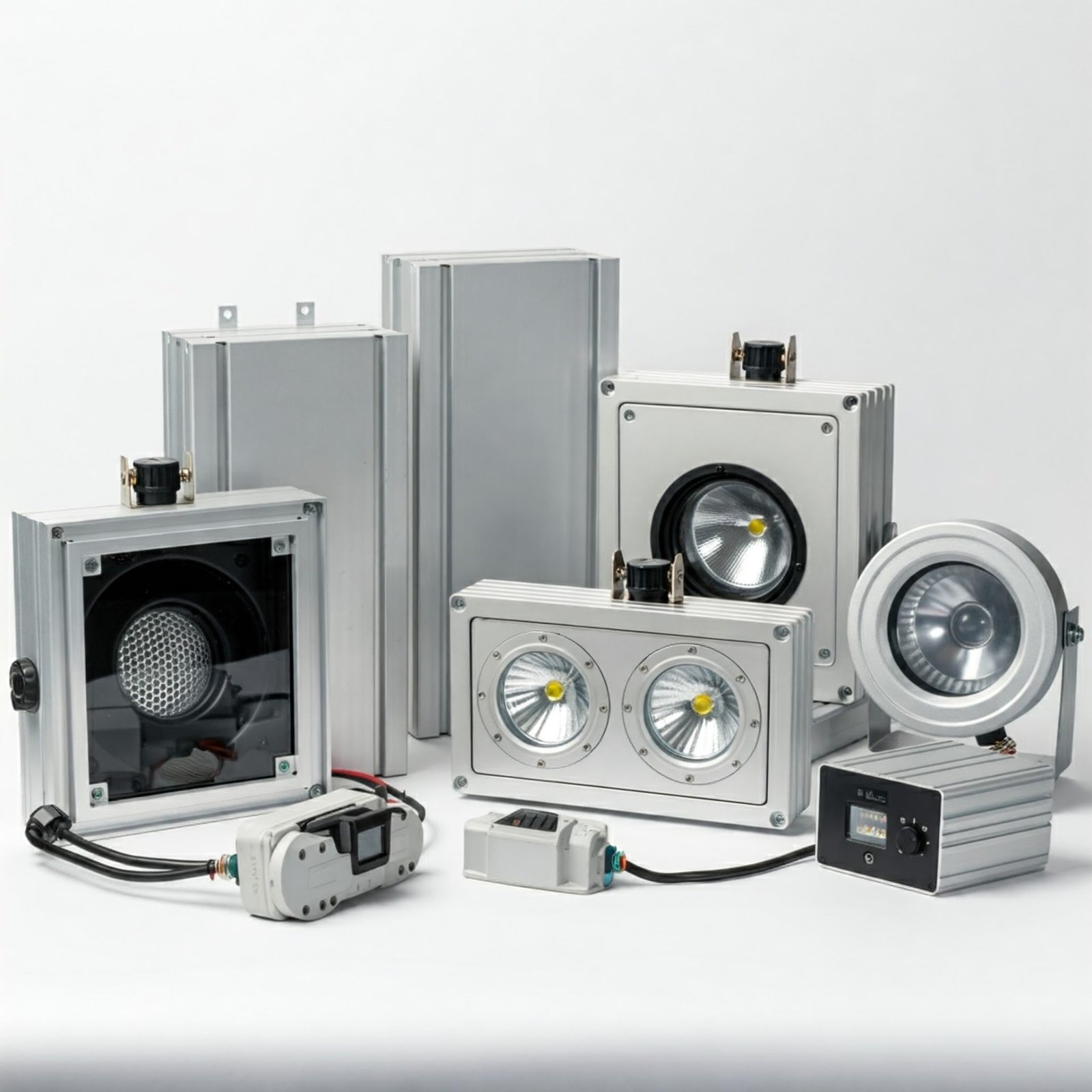
Durable and Precision-Engineered Aluminium Lighting Enclosures
Our aluminium lighting enclosures are crafted for superior protection, weather resistance, and durability, ensuring reliable performance in lighting systems.
Precision-crafted aluminium lighting enclosures, offering durable and weather-resistant solutions for protecting lighting systems in diverse environments.
At Conex Aluminium Components, we manufacture high-quality aluminium lighting enclosures, designed to protect lighting systems in outdoor, industrial, and commercial applications. These enclosures provide excellent weather resistance, corrosion protection, and durability, ensuring optimal performance in challenging conditions. Lightweight yet robust, our enclosures are available in various sizes and designs, tailored to meet specific requirements. With a focus on precision and quality, Conex ensures that each enclosure meets industry standards for safety and reliability.
Aluminium lighting enclosures protect LED modules, drivers, optics, terminals and wiring from impact, dust, moisture and environmental exposure. They also provide mounting features and a thermal path for heat dissipation. The enclosure design must suit the luminaire type, power, ingress rating, installation orientation, ambient temperature and service environment.
Aluminium combines low weight, corrosion resistance, castability, machinability and high thermal conductivity. It can transfer heat away from LEDs and drivers while providing a rigid enclosure. Alloy, wall thickness, fins, coating and mounting design must be coordinated so structural, thermal and weatherproofing requirements are achieved together.
Ingress protection depends on the complete assembled luminaire: housing joints, gasket compression, lens interface, fasteners, cable glands, vents and drainage. Machined or cast sealing lands must be continuous and controlled. The target IP rating and test standard should be defined so the enclosure, seals and assembly process can be validated under realistic conditions.
Heat flows from the LED board through thermal interfaces into the aluminium housing and then to ambient air by conduction, convection and radiation. Fins, wall thickness, surface area, orientation and airflow influence temperature. Thermal design should use LED power, driver losses, ambient range, coating and allowable junction temperature rather than relying only on housing mass.
Enclosures can incorporate machined LED-board seats, flat heat-spreader surfaces, fins, bosses and mounting pads. Interface flatness, roughness, fastener pattern and thermal compound or pad thickness affect contact resistance. These details should be defined with the LED module and driver arrangement so heat transfer remains stable after assembly.
High-pressure die casting suits high-volume thin-walled housings with detailed fins, while gravity die or sand casting may suit larger sections, lower volumes or heat-treatable alloys. Extrusion and machining may suit linear luminaires. Process choice depends on volume, geometry, thermal features, finish, tooling budget and ingress requirements.
The enclosure can include lens seats, reflector interfaces, gasket grooves, retaining screws or clips. Optical alignment, seal compression and thermal expansion must be controlled without distorting the lens. Drawings should define datums, clearances, surface finish and allowable flash around optical openings to protect beam quality and ingress performance.
Gasket selection depends on temperature, UV exposure, ozone, chemicals, compression set and target IP rating. Silicone, EPDM or other elastomers may be suitable depending on service. Groove dimensions, joint gap, fastener spacing and compression must match the gasket profile. Material approval should consider the complete luminaire environment.
Condensation can result from temperature cycling and humid air exchange even when rain is excluded. Controlled breathable vents, drainage paths, moisture-resistant components and correct gasket design can reduce risk. Vent placement must preserve IP performance and prevent direct water entry. Thermal analysis should consider nighttime cooling and solar heating.
They perform well in many environments when the alloy and finish are matched to exposure. Coastal salt, industrial pollutants, dissimilar fasteners and trapped water increase risk. Conversion coating, powder coating, anodising, compatible hardware, drainage and isolation may be required. Coating damage at threads and mounting points should be controlled.
Protective-earth points require reliable metal-to-metal contact despite paint or powder coating. The design may use masked pads, serrated washers, grounding studs or dedicated bonding features. Ground continuity, corrosion protection and fastener retention must follow the applicable luminaire safety standard. Decorative coating should not unintentionally insulate the earth path.
Only when the complete luminaire is specifically designed, tested and certified for the hazardous-location classification and protection concept. A standard enclosure is not automatically explosion-proof. Flame paths, joint dimensions, temperature class, impact resistance, glands, fasteners and certification requirements must be established by qualified hazardous-area design.
Options may include as-cast, shot-blasted, conversion-coated, anodised, painted or powder-coated surfaces. Exterior coatings should meet UV, corrosion and colour requirements while preserving heat dissipation. Masking may be needed for LED seats, lens seals, threads and grounding points. Cosmetic acceptance criteria should identify visible surfaces.
Inspection can include material and dimensional checks, sealing-land flatness, threads, coating, lens fit and grounding features. Complete luminaires may require IP, thermal, impact, corrosion, dielectric and earth-continuity tests to applicable standards. Critical dimensions, sampling and certification scope should be agreed before production.
Provide 3D CAD, drawings, LED and driver power, optical components, target IP and safety standard, ambient temperature, mounting orientation, alloy, casting volume, thermal limits, gasket and gland details, coating, grounding, tests, certifications and quantity. Complete assembly information is necessary to assess thermal and sealing performance.
Need Aluminium Lighting Enclosures? Get a Fast, Detailed Quotation
Send your drawing (STEP, IGES, DWG, DXF or PDF) with material grade, finish and quantity. Our engineers reply with a DFM review, price and lead time. MOQ 10 pcs • ISO 9001:2015 • Exports to USA, UK, Europe, Canada & Australia.


