

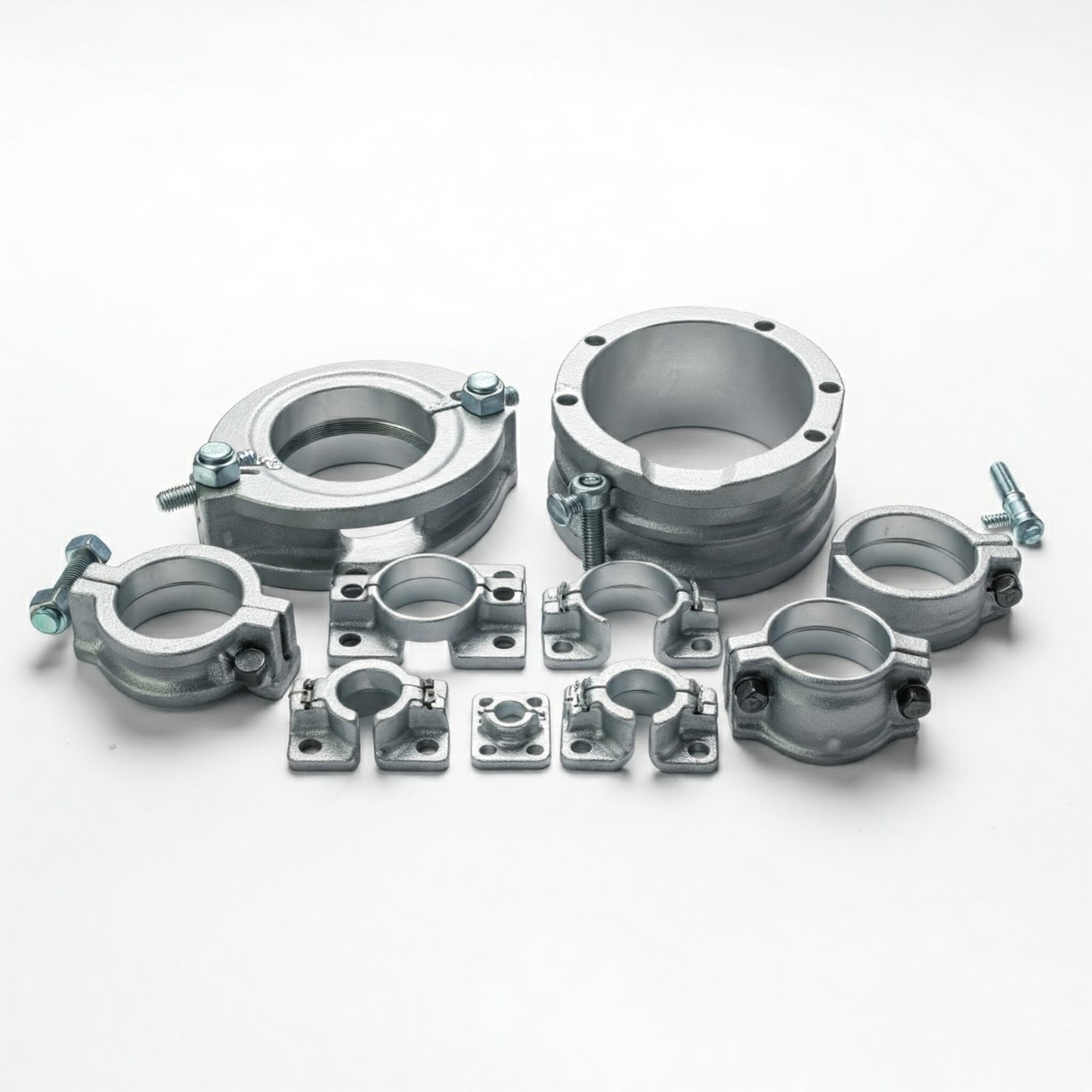
Durable and Precision-Engineered Aluminium Pipe Saddles & Pipe Clamps
Our aluminium pipe saddles and pipe clamps are crafted for secure pipe support, offering excellent durability, corrosion resistance, and reliable performance.
High-quality aluminium pipe saddles and pipe clamps designed for secure and reliable pipe support in diverse industrial and commercial applications.
At Conex Aluminium Components, we specialize in manufacturing premium aluminium pipe saddles and pipe clamps that cater to plumbing, construction, and industrial needs. These components provide secure pipe support and ensure reliable performance in demanding environments. Made from corrosion-resistant aluminium, our pipe saddles and clamps are lightweight yet durable, offering easy installation and long-lasting service. Available in a variety of sizes and designs, they are suitable for various pipe diameters and configurations. With a commitment to quality and customization, Conex delivers solutions tailored to specific requirements.
Aluminium pipe saddles and clamps support, position or restrain pipes and tubes on walls, frames, machinery and structural members. The saddle distributes contact over a curved seat, while the clamp or strap retains the pipe. Selection depends on pipe outside diameter, load direction, support spacing, vibration, temperature, environment and whether the point is fixed or allows movement.
Use the pipe’s actual outside diameter, including any coating, insulation sleeve or liner, rather than relying only on nominal pipe size. Saddle radius, clamp opening, fastener spacing and mounting clearance must suit the installation. A proper fit supports the pipe evenly without excessive gap, point contact, forced alignment or crushing of thin-wall tubing.
A pipe saddle primarily provides a shaped support beneath the pipe, whereas a full clamp or strap also retains it against lifting or lateral movement. Some assemblies combine both functions. The appropriate design depends on gravity load, uplift, vibration, movement and maintenance requirements. The intended function should be defined before selecting the hardware.
Alloy selection considers strength, corrosion resistance, formability, machinability, weldability and surface treatment. The required grade and temper depend on saddle geometry, section thickness, design load and service environment. Conex reviews the technical drawing and application conditions before confirming material, and material certification can be specified as part of the quality requirements.
Capacity depends on pipe diameter, saddle contact area, clamp section, alloy and temper, fastener size, mounting pattern, support structure and direction of loading. Dynamic effects from vibration, pressure pulsation, impact and thermal movement must also be included. Project loads and safety factors should be supplied so the complete assembly—not only the aluminium body—can be reviewed.
Aluminium performs well in many outdoor installations when the alloy, finish and hardware are properly selected. Coastal salt, industrial chemicals, standing water and contact with dissimilar metals can still accelerate corrosion. Anodising, conversion coating, powder coating, compatible fasteners and drainage or isolation details may be specified according to the exposure condition.
Risk is controlled by avoiding direct unprotected contact between aluminium and incompatible metals in wet conditions. Non-conductive liners, isolating washers, sleeves, sealants, compatible fasteners and protective coatings can interrupt the galvanic path and exclude moisture. The pipe, saddle, clamp strap, bolts and mounting structure should all be considered during material selection.
Yes. Liners can protect coatings, reduce noise, provide electrical isolation and absorb limited vibration. The liner material must withstand operating temperature, chemicals, compression and ageing without excessive creep. Its thickness changes the effective clamp diameter, so it must be included in the design and retained so it cannot shift or extrude during tightening.
Support spacing is determined by pipe material, diameter, wall thickness, fluid weight, insulation, temperature, orientation and applicable piping code. Excessive spacing can cause sagging and high bending loads; overly rigid spacing can restrict thermal movement. The piping designer should define the support plan, while the saddle and clamp are manufactured to suit the resulting loads and interfaces.
They can be configured as fixed supports, guides or sliding supports, but the function must be deliberate. Thermal expansion depends on pipe material, length and temperature range. Where movement is required, the saddle surface, liner, clearance and fastener arrangement should guide the pipe without binding. Fixed points must be designed to carry the resulting axial forces.
Mount the saddle on a clean, aligned and structurally adequate surface. Seat the pipe evenly, fit any liner correctly and tighten fasteners in a controlled sequence using the approved torque. Installation should not force the pipe out of alignment or damage its coating. Final checks confirm contact, clearance, bolt engagement and the intended fixed, guided or sliding condition.
Options may include as-machined or as-formed surfaces, deburring, polishing, anodising, conversion coating and powder coating. The drawing should specify colour, coating thickness, masking zones, cosmetic criteria and any surfaces that require electrical contact or controlled friction. Finish compatibility with the selected alloy, fasteners, liner and environment should be reviewed before production.
Yes. Custom features can include non-standard diameters, saddle angles, section thickness, bolt patterns, slots, hinge details, straps, liners, mounting feet, coatings and identification marks. Conex requires a drawing or sample plus pipe data, loads, environment and installation constraints to review manufacturability, tolerances, tooling and batch quantity.
Inspection can cover material, pipe-seat radius, overall dimensions, hole location, profile, flatness, edge condition, fastener fit and surface finish. Functional gauges or representative pipe sections may be used to confirm seating and closure. Material certificates, dimensional reports and coating documentation can be supplied when defined in the purchase and quality specifications.
Provide pipe outside diameter and material, saddle or clamp drawing, operating load, support spacing, orientation, temperature range, vibration, environment, mounting structure, fastener grade, liner, surface finish, applicable standard and quantity. State whether the support is fixed, guided or sliding so Conex can assess the correct geometry and manufacturing route.
Need Aluminium Pipe Saddles Pipe Clamps? Get a Fast, Detailed Quotation
Send your drawing (STEP, IGES, DWG, DXF or PDF) with material grade, finish and quantity. Our engineers reply with a DFM review, price and lead time. MOQ 10 pcs • ISO 9001:2015 • Exports to USA, UK, Europe, Canada & Australia.


