About Conex

Welcome to Conex Aluminium Components, a leading manufacturer and exporter of high-quality, precision-engineered non-ferrous metal components worldwide.

Contact Info

  • Plot 1, Street No 1, Road No 1
  • sales@conexaluminium.com
  • Sat - Thu: 09.00 to 18.00

Aluminium Mechanical Lugs Mechanical Connectors

Conex > Products Range > Aluminium Electrical Components > Aluminium Mechanical Lugs Mechanical Connectors
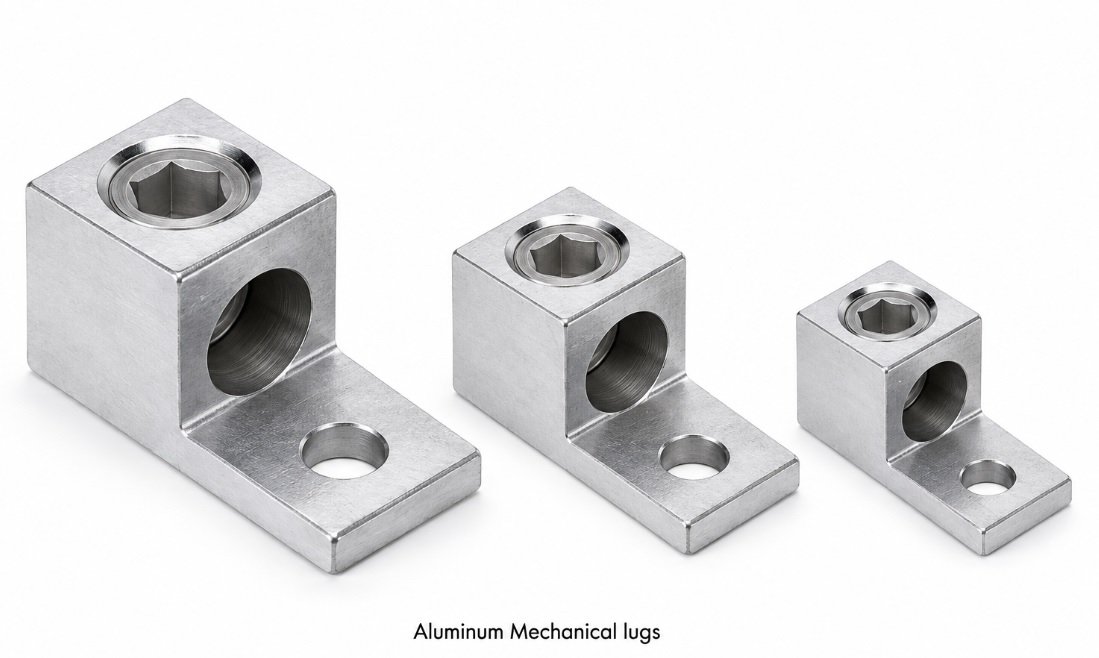
Aluminium mechanical lugs and connectors

Durable and Precision-Engineered Aluminium Mechanical Lugs & Connectors

Our aluminium mechanical lugs and connectors are designed to ensure secure and efficient electrical connections, offering superior performance and reliability.

High-quality aluminium mechanical lugs and connectors, crafted for superior conductivity, durability, and ease of installation in diverse industrial applications.

At Conex Aluminium Components, we manufacture top-grade aluminium mechanical lugs and connectors to meet the demands of electrical and industrial systems. These components provide secure and efficient connections, ensuring reliable conductivity and corrosion resistance. Ideal for power distribution, industrial machinery, and electrical panels, our mechanical lugs and connectors are available in various sizes and designs. With a focus on quality and customization, we offer tailored solutions to meet specific project requirements, ensuring safety and performance.

Use only conductor materials listed for the specific lug. Many aluminium mechanical connectors are designed for aluminium conductors, while dual-rated designs may accept copper; mixed-metal applications require suitable plating, compounds and approvals to control galvanic corrosion.

Match the cable material, cross-sectional area, strand class and actual conductor diameter to the lug’s published range. Also verify palm dimensions, stud-hole size, equipment terminal geometry, current duty, voltage class, enclosure clearance and applicable standard.

Set-screw lugs are tightened to a specified torque with a calibrated tool. Shear-bolt lugs use engineered bolt heads that break at a controlled level, simplifying installation across a stated conductor range while still requiring the prescribed tightening sequence.

Barrel diameter, length and internal profile determine conductor engagement, pressure distribution and contact area. Correct geometry limits strand damage, supports oxide disruption and helps the joint remain stable during load cycling.

De-energize and verify the circuit, cut the conductor square, strip insulation to the specified length and avoid nicking strands. Clean the exposed aluminium with an approved brush, apply compatible inhibitor where required, and insert the conductor fully before tightening.

Follow the exact connector instructions, including bolt sequence, staged tightening and final torque or shear-head break-off. Using an uncalibrated tool, reusing a shear bolt or exceeding torque can damage threads, distort the barrel or reduce conductor integrity.

A low-resistance joint relies on clean conductor surfaces, adequate insertion depth and sustained interface pressure. Proper alloy selection, internal surface design, oxide inhibitor and controlled tightening reduce films and voids that can cause localized heating.

Only when the lug is approved for the relevant strand class. Flexible conductors may need a compatible sleeve or special insert so set screws do not cut or displace strands; standard ferrules should not be improvised unless the connector system specifies them.

For dissimilar-metal interfaces, use a connector and terminal arrangement specifically rated for the combination, with appropriate plating, separator or inhibitor. Keep moisture out of the joint and avoid direct aluminium-to-copper contact unless the product design expressly permits it.

Suitability depends on the lug, enclosure and sealing system. Outdoor designs must address condensation, water ingress, salt or industrial contamination, compatible insulating boots or heat-shrink, and corrosion-resistant hardware.

Reuse is acceptable only if the manufacturer allows it. Shear bolts are normally single-use, and any lug with damaged threads, distorted barrel, overheated surfaces, corrosion or questionable clamping components should be replaced.

Typical causes are an incorrect conductor range, incomplete insertion, oxide-contaminated strands, missing inhibitor, wrong tightening sequence, insufficient torque, strand damage or loose equipment hardware. These defects reduce contact area and increase electrical resistance.

Inspection covers material identification, cable range, strip length, insertion, bolt engagement, torque or shear-head condition, palm alignment and sealing. Project requirements may add dimensional checks, resistance or heat-cycle qualification, pull-out testing and infrared inspection after energization.

Provide conductor material, cross-section, diameter and strand class; equipment stud and palm dimensions; current and voltage context; set-screw or shear-bolt preference; installation environment; standard, plating, testing, certification and quantity. A drawing or sample allows Conex to review barrel, palm and hardware details.

Need Aluminium Mechanical Lugs Mechanical Connectors? Get a Fast, Detailed Quotation

Send your drawing (STEP, IGES, DWG, DXF or PDF) with material grade, finish and quantity. Our engineers reply with a DFM review, price and lead time. MOQ 10 pcs • ISO 9001:2015 • Exports to USA, UK, Europe, Canada & Australia.