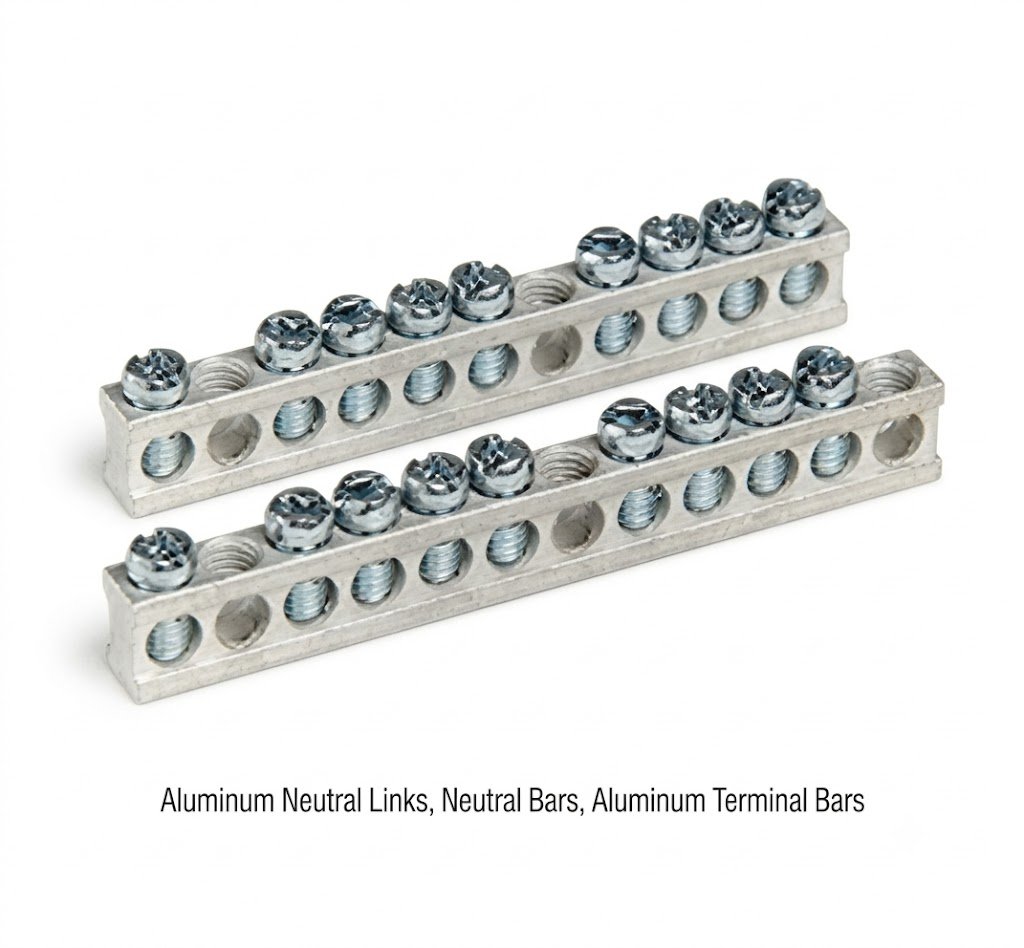
Durable and Precision-Engineered Aluminium Terminals Neutral Links Bars
Our aluminium terminals neutral links bars are designed to ensure secure and efficient electrical connections, offering excellent conductivity and durability in various systems.
Reliable aluminium terminals neutral links bars, precision-engineered for electrical connections, ensuring durability and superior conductivity.
At Conex Aluminium Components, we specialize in manufacturing high-quality aluminium terminals neutral links bars for use in electrical panels and power distribution systems. These components are crafted to provide reliable and efficient electrical connections. Made from premium aluminium, they ensure superior conductivity, corrosion resistance, and durability. Available in various sizes and configurations, our terminals and links bars are easy to install and maintain, meeting industry standards for safety and performance. We also offer customized solutions tailored to specific project requirements.
Aluminium terminals and neutral link bars distribute or collect conductors in panelboards, switchboards, meter boards and industrial control assemblies. They provide organized connection points for neutral, phase or equipment circuits according to the design and must be applied only in their specified function.
A neutral link carries normal return current and may be isolated from the enclosure downstream of the main bonding point. An earth bar connects protective conductors to the grounding system and enclosure; bonding, isolation and conductor identification must follow the applicable wiring rules.
Alloy and temper are chosen for electrical conductivity, mechanical strength, thread performance, corrosion resistance and machinability. The section size and heat-rise limit matter as much as bulk conductivity, so material selection should be verified for the full assembly duty.
Current capacity depends on alloy conductivity, bar cross-section, connection resistance, terminal spacing, enclosure ventilation, ambient temperature and permitted temperature rise. The rating should be established by design calculation and, where required, temperature-rise testing in the representative assembly.
Only the number, sizes, materials and strand classes specified for that terminal may be installed. Placing multiple conductors under a screw not designed for them can create uneven pressure, loose strands and excessive heating.
Pitch must provide sufficient metal around each threaded hole, space for cable entry and tool access, and required electrical clearances. Crowded terminals can weaken threads, force sharp cable bends and increase the risk of strand contact between adjacent circuits.
Use the torque defined for the exact screw, thread, conductor range and terminal design, applied with a calibrated tool. Under-tightening raises contact resistance, while excessive torque can strip aluminium threads, deform the conductor or crack the terminal section.
Only when the terminal assembly is identified for copper or dual-rated service. Suitable plating, contact compound, separator design and environmental sealing may be needed to manage galvanic corrosion and the different thermal behavior of copper and aluminium.
Isolation and bonding depend on the system earthing arrangement and the bar’s location relative to the service bonding point. Use approved insulating supports and bonding hardware, maintain required clearances, and follow the equipment design and local electrical code rather than assuming neutral and earth are interchangeable.
Adequate bar cross-section, clean contact surfaces, correct conductor preparation, controlled torque and suitable spacing limit resistive losses. Enclosure temperature, grouping, harmonics, load imbalance and ventilation should also be considered because neutral current may be significant.
Finishes may include tin or other specified plating to improve contact compatibility and corrosion performance. The finish must suit the conductor material, mating hardware and environment; decorative coatings must not cover current-carrying contact areas unless specifically engineered for that purpose.
They can be when alloy, plating, creepage distance, enclosure protection and sealing are selected for the exposure. Condensation, salt, chemical vapors and conductive dust can attack interfaces, so environmental testing or additional protection may be required.
Common faults include loose screws, wrong conductor range, damaged strands, oxide contamination, copper-aluminium mismatch, overloaded terminals, shared holes not rated for multiple conductors and poor bar-to-bus connections. Load imbalance or harmonic current can further increase neutral heating.
Inspection covers alloy or plating, dimensions, terminal pitch, hole and thread quality, flatness, markings and torque records. Depending on the specification, testing can include conductivity, contact resistance, pull-out, temperature rise, dielectric clearance and short-time-current performance.
Provide the electrical function, system current and voltage, conductor materials and ranges, number of ways, bar section and length, terminal pitch, hole and thread details, mounting or isolation method, finish, standard, testing, certification and quantity. Assembly drawings or samples help Conex confirm fit and manufacturability.
Need Aluminium Terminals Neutral Links Bars? Get a Fast, Detailed Quotation
Send your drawing (STEP, IGES, DWG, DXF or PDF) with material grade, finish and quantity. Our engineers reply with a DFM review, price and lead time. MOQ 10 pcs • ISO 9001:2015 • Exports to USA, UK, Europe, Canada & Australia.