

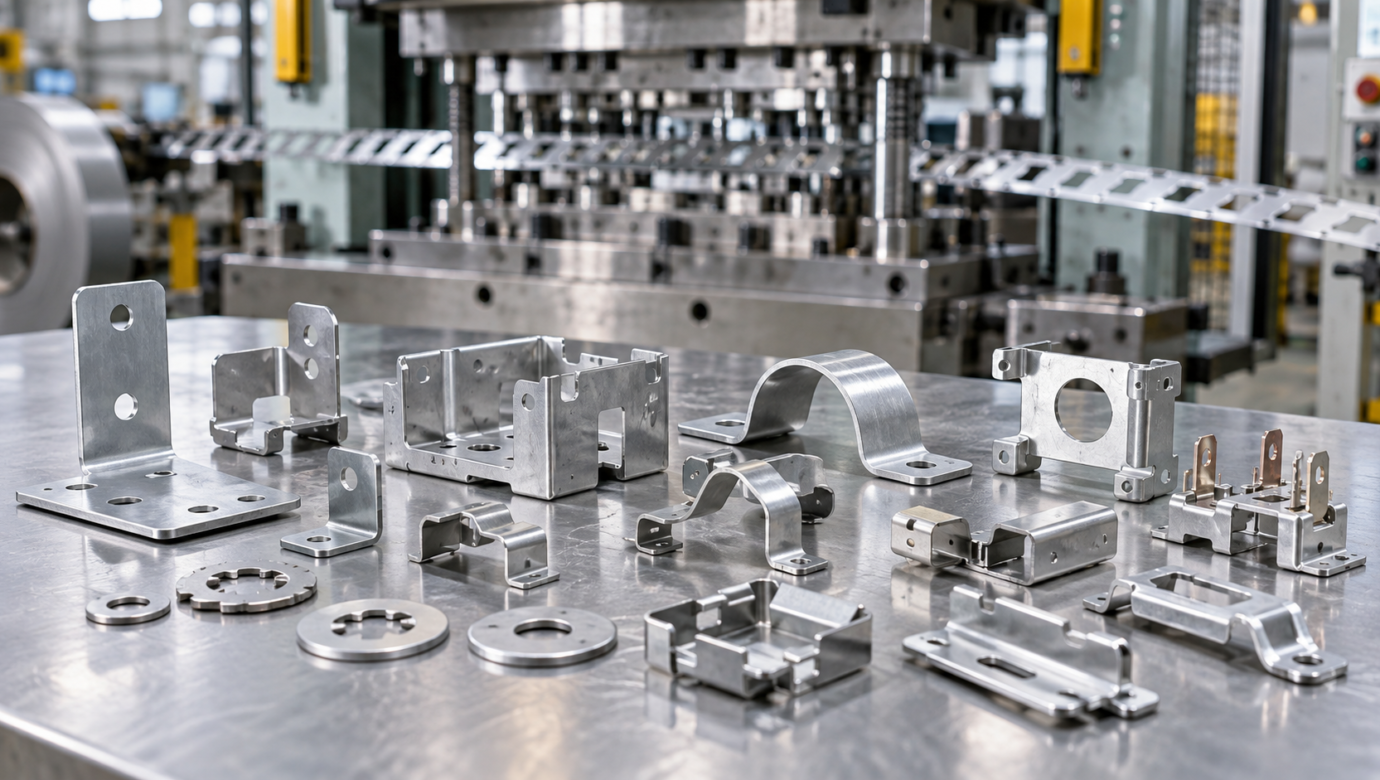
Aluminum Stamped Parts and Stamped Components
Aluminum Stamped Parts and Stamped Components
Aluminum Stamped Parts and Stamped Components
Aluminum stamped parts combine low weight, corrosion resistance and production efficiency. From simple washers and brackets to multi-stage electrical contacts and formed enclosures, stamping can produce repeatable components at a competitive unit cost when tooling, alloy, temper and quality controls are planned together.
This guide explains stamping methods, design rules, tooling, tolerances, finishes, inspection and sourcing for OEM engineers and purchasing teams.
What Is Aluminum Metal Stamping?
Stamping uses a press and dedicated tooling to cut or form aluminum sheet or coil. Operations include blanking, piercing, bending, embossing, coining, drawing and trimming. A part may be produced in one operation, a compound tool or a progressive die that performs several stages as material advances through the press.
Why Choose Aluminum for Stamped Components?
- Excellent strength-to-weight ratio
- Useful electrical and thermal conductivity
- Natural corrosion resistance
- Good formability in suitable alloys and tempers
- Compatibility with anodizing, plating, painting and conversion coatings
- Recyclable production scrap
Typical Applications
Stamped aluminum components are used as electrical contacts, terminal plates, mounting brackets, clips, shields, covers, heat-spreading parts, washers, spacers, battery components, cable-management hardware and light structural supports. The production route must match both functional and cosmetic expectations.
Key Stamping Operations
Blanking and piercing
Blanking creates the outside profile, while piercing produces holes and internal cut-outs. Punch-to-die clearance influences burr height, edge quality and tool life.
Bending and forming
Material is formed around a radius. Grain direction, temper, thickness and inside bend radius affect cracking and springback.
Coining and embossing
Localized pressure creates stiffening ribs, marks, contact features or controlled geometry.
Progressive-die stamping
Coil advances through multiple stations, allowing complex parts to be pierced, formed and cut off at high production rates.
Deep drawing
A flat blank is drawn into a cup or shell. Draw ratio, lubrication and intermediate operations require careful engineering.
Alloy and Temper Selection
Soft tempers generally form more easily; stronger tempers may require larger radii or intermediate processing. 1000-, 3000-, 5000- and 6000-series alloys cover many electrical, corrosion-resistant and structural needs. Specify alloy, temper, thickness and governing material standard. A generic callout such as “aluminum sheet” is not enough for repeat production.
Design Guidelines
- Keep hole diameter and edge distance appropriate for material thickness.
- Use bend radii suitable for the alloy and temper.
- Allow for springback in critical angles.
- Avoid narrow webs that weaken the strip or part.
- Place burr direction away from mating, sealing and handling surfaces.
- Define flatness only where function requires it.
- Use ribs, beads or flanges to increase stiffness efficiently.
- Design features for reliable carrier-strip support in progressive tooling.
Tooling Strategy and Production Volume
Prototype and low-volume parts may use laser-cut blanks and simple forming tools. Medium volumes may justify compound or transfer tooling. Progressive dies usually deliver the best cycle time at sustained high volumes but require greater up-front investment. Buyers should compare total annual cost, expected product life, engineering changes and spare-tool maintenance—not tooling price alone.
Tolerances and Edge Quality
Stamped dimensions are influenced by material thickness, coil properties, tooling clearance, die wear and springback. Critical hole locations and formed datums should be identified on the drawing. Cut edges naturally contain rollover, burnish, fracture and burr zones; specify burr limits and edge orientation based on function.
Secondary Operations
Stamped components may require tapping, machining, riveting, welding, cleaning, tumbling, heat treatment, plating, anodizing, powder coating, marking or assembly. The sequence matters. For example, coating thickness can alter holes and electrical contact, while welding can affect flatness.
Quality Control
A control plan can cover incoming coil certification, first-off approval, in-process dimensions, burr height, bend angle, visual finish, gauge checks and final sampling. Optical systems and dedicated fixtures can speed inspection. Tool-maintenance records help identify gradual drift before parts move outside limits.
Reducing Cost Without Reducing Performance
- Standardize material thicknesses and finishes where practical.
- Separate critical tolerances from general tolerances.
- Design for common tooling and press capacity.
- Optimize strip layout and material utilization.
- Review whether separate parts can be combined—or one complex part simplified.
- Freeze key interfaces before hard tooling.
Information Needed for a Quotation
Provide 2D drawings, 3D models, alloy, temper, thickness, finish, annual volume, batch quantity, critical dimensions, burr direction, packaging, inspection documents and expected programme life. State whether tooling will be buyer-owned and how engineering revisions should be controlled.
Frequently Asked Questions
1. What is the difference between stamping and pressing?
Stamping is a broad press-based process that includes cutting and forming; pressing may refer more generally to forming with a press.
2. Which aluminum alloys can be stamped?
Many can, but formability varies with alloy and temper. The part geometry must be reviewed with the material condition.
3. What is a progressive die?
It is a multi-station tool that performs successive operations as coil strip advances through the press.
4. When is dedicated tooling economical?
Usually when repeat volume and programme life recover the tooling investment through lower unit cost and consistency.
5. What causes springback?
Elastic recovery after forming changes the final angle or shape. Alloy, temper, radius and process strategy influence it.
6. Can stamped parts be anodized?
Yes, when the alloy, surface condition and dimensional allowances are compatible.
7. How is burr controlled?
Correct die clearance, sharp tooling, stable material and planned maintenance reduce burr growth.
8. Can threads be stamped?
Some thread forms can be created or extruded, while others require tapping or inserts after stamping.
9. What is strip layout?
It defines how parts and carrier features are arranged across the coil to balance material use and tool stability.
10. Are tight tolerances possible?
Yes on selected features, but tolerance must reflect the operation, material and measurement method.
11. How are cosmetic surfaces protected?
Protective film, clean tooling, controlled handling and suitable packaging can be specified.
12. Can stamping include assembly?
Secondary riveting, insertion, welding or subassembly can often be integrated into the supply route.
13. What causes cracks at bends?
Small radii, hard temper, unfavourable grain direction, damaged edges or excessive forming strain are common causes.
14. What should a prototype prove?
Fit, interface geometry, material behaviour and assembly function before production tooling is finalized.
15. Can Conex manufacture custom stamped components?
Conex can review buyer drawings for custom aluminum parts; feasibility depends on geometry, alloy, tolerances, finish and volume.
Develop Your Custom Stamped Aluminum Part
Share your drawing, material, volume and finish with Conex Aluminium Components for a manufacturability and quotation review.
Contact Conex for stamped aluminum components or explore the product range.