

Aluminum Pressing and Pressed Components
Aluminum Pressing and Pressed Components
Aluminum Pressing and Pressed Components
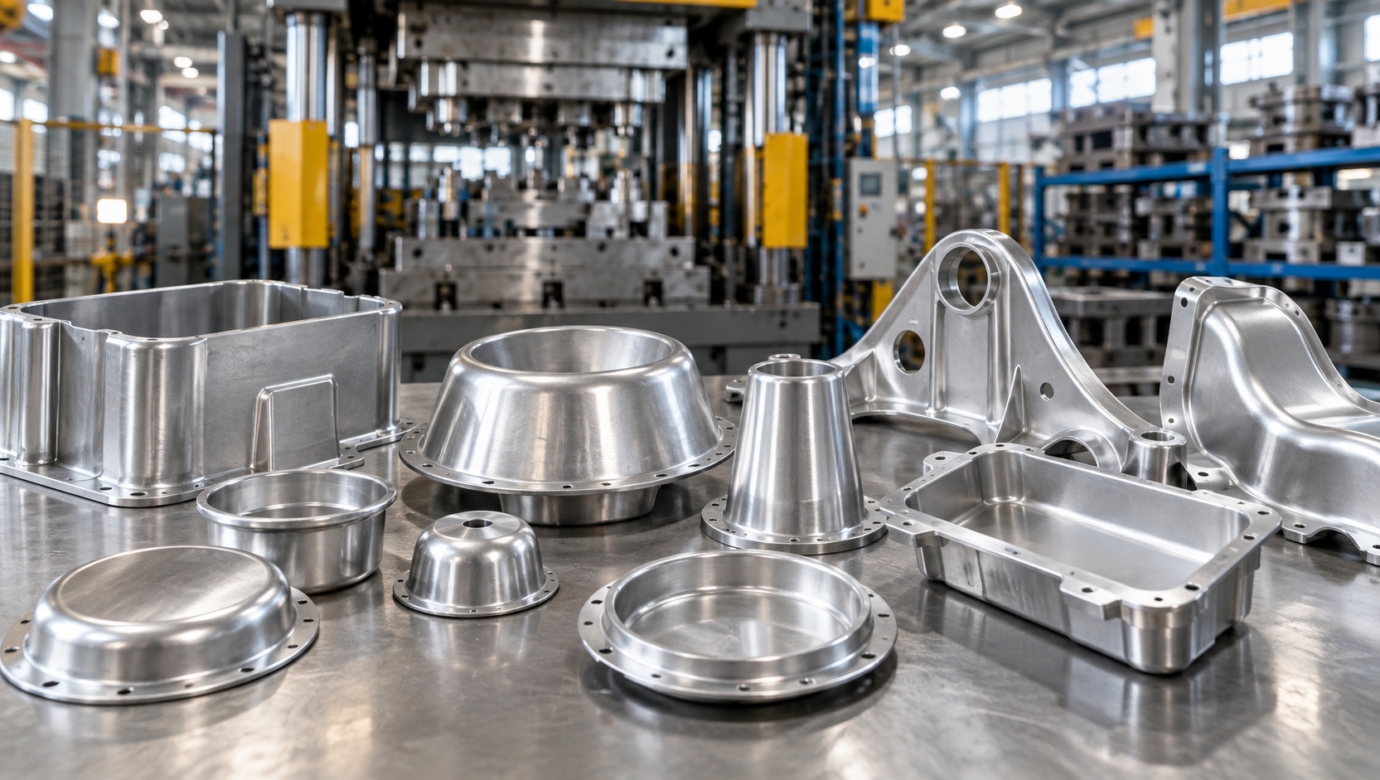
Aluminum pressing turns flat sheet, coil or preforms into strong three-dimensional components by applying controlled force through matched tooling. Pressed parts can replace heavier fabrications, reduce assembly steps and create stiff shapes with smooth transitions. Successful production depends on material formability, tooling, lubrication, strain distribution and control of springback.
This practical guide covers pressed aluminum components for electrical, automotive, industrial, renewable-energy and equipment applications.
What Are Aluminum Pressed Components?
Pressed components are formed in a mechanical, hydraulic or servo press. Unlike machining, which removes material, pressing redistributes it. Processes range from a single bend to deep-drawn housings, flanged covers, channels, shells and reinforced panels. Cutting, trimming and piercing may happen before, during or after forming.
Why Use Pressed Aluminum?
- Low component weight
- High stiffness when ribs, flanges and curved geometry are used
- Efficient material use at repeat volumes
- Consistent geometry from dedicated tooling
- Good corrosion resistance
- Compatibility with anodizing, painting and other finishes
- Potential to consolidate welded or fastened assemblies
Main Aluminum Pressing Processes
Brake and die bending
Produces angles, channels, flanges and profiles. Bend allowance, radius and springback determine the developed blank.
Shallow drawing
Forms trays, covers and housings with moderate depth. Corner radii and flange behaviour require attention.
Deep drawing
Draws a blank into a deeper cup or shell. Blank-holder force, draw ratio, lubrication and staged redraws control wrinkling and tearing.
Embossing and beading
Adds local stiffness, locating features, identification or clearance without major added mass.
Coining and calibration
Applies high local pressure to refine dimensions or create defined features.
Hydraulic and servo pressing
Controllable force and motion profiles can improve forming of complex geometries and sensitive materials.
Material Selection
Formability depends strongly on alloy and temper. Softer 1000- and 3000-series materials suit many drawn parts; selected 5000-series alloys provide useful strength and corrosion resistance. Heat-treatable alloys may require careful temper selection and post-forming treatment. Drawings should specify the alloy, temper, thickness and material standard together.
Design Rules for Pressed Parts
- Use generous, consistent radii where geometry permits.
- Avoid abrupt section changes that concentrate strain.
- Allow practical draft and tool access.
- Place holes and slots far enough from bends and draw zones.
- Use beads, ribs and flanges to gain stiffness without excessive thickness.
- Define which surfaces control assembly.
- Account for coating or plating thickness.
- Specify cosmetic zones and permissible forming marks.
Understanding Springback
After the press load is removed, elastic recovery changes angles and dimensions. Higher-strength tempers often show more springback. Tool compensation, over-bending, restriking and controlled process parameters can improve consistency. A drawing should not assume that every formed feature behaves like a machined surface.
Wrinkling, Tearing and Surface Marks
Wrinkling occurs when compressive stresses buckle material, often in a flange or wall. Tearing occurs when tensile strain exceeds material capability. Surface scratches and pickup may result from contaminated tooling or poor lubrication. Tool radii, blank shape, holder pressure, lubricant and material direction must be tuned as a system.
Tooling and Volume Strategy
Simple press-brake tooling can be economical for prototypes and short runs. Dedicated draw dies provide repeatability at higher volumes. Multi-stage, transfer or progressive systems can combine forming, trimming and piercing. The business case should include tool life, maintenance, change control, forecast volume and the cost of secondary operations.
Secondary Operations and Finishes
Pressed parts may be trimmed, pierced, machined, tapped, welded, riveted or assembled. Finishes include anodizing, conversion coating, powder coating, painting and selected plating. Cleaning after forming is important because lubricant residue can interfere with coating, welding or electrical contact.
Inspection and Validation
Quality plans may check blank size, material certification, wall thickness, flange dimensions, profile, hole position, flatness, surface condition and coating. Checking fixtures provide fast production verification, while CMM or optical scanning can validate complex profiles. First-article parts should be evaluated in the real assembly whenever possible.
Pressed Parts vs Machined or Fabricated Parts
Machining offers flexibility and accurate local features but may remove substantial material. Fabrication suits large parts and lower quantities but adds joints and distortion risk. Pressing becomes attractive when a thin-wall shape, repeat volume and part consolidation justify tooling. Hybrid routes—pressed shells with finish-machined interfaces—often provide the best balance.
Preparing an Effective RFQ
- Send controlled 2D and 3D data.
- State alloy, temper, thickness and finish.
- Identify critical interfaces and cosmetic surfaces.
- Provide annual volume and batch schedule.
- Define inspection reports, samples and testing.
- Specify packaging and surface-protection needs.
- Clarify tool ownership, maintenance and revision control.
Frequently Asked Questions
1. Is pressing the same as stamping?
Pressing is the broader use of press force; stamping commonly includes cutting and forming sheet or coil in dedicated dies.
2. What aluminum is best for deep drawing?
Highly formable alloys and softer tempers are often preferred, but the best choice depends on strength, corrosion and finish requirements.
3. What is draw ratio?
It relates blank size to punch or cup size and helps indicate whether a draw can be completed safely in one or more stages.
4. Why do pressed parts wrinkle?
Uncontrolled compressive stress, blank-holder force, blank shape or material flow can create wrinkles.
5. What causes tearing?
Excessive tensile strain, small radii, hard material, poor lubrication or an aggressive draw can split the part.
6. Can holes be made before forming?
Sometimes, but holes near strain zones may distort. The operation sequence should be validated.
7. How is springback controlled?
Tool compensation, over-bending, restriking, material control and repeatable press parameters are common methods.
8. Can pressed aluminum be welded?
Yes for suitable alloys and joint designs, with attention to heat distortion, cleanliness and required strength.
9. Are forming marks acceptable?
Acceptance depends on the drawing and cosmetic specification. Critical appearance zones should be identified.
10. Can pressed parts be anodized?
Yes, but alloy, surface condition and forming strain can influence appearance.
11. When should a checking fixture be used?
It is valuable for repeat, fast verification of profiles and assembly interfaces at production volume.
12. Can prototypes be made without production tooling?
Often yes, using soft tooling, press brakes, machining or incremental methods to validate the design.
13. How is wall thinning measured?
Thickness gauges, sectioning or approved non-destructive techniques can compare formed zones with the original sheet.
14. What reduces pressed-part cost?
Stable volumes, manufacturable radii, common materials, efficient blanks and fewer secondary operations reduce total cost.
15. What should be sent to Conex?
Provide drawings, models, material, finish, quantities, critical dimensions, application details and quality requirements.
Plan Your Custom Aluminum Pressing Project
Conex Aluminium Components can review pressed-component drawings for material, process, tooling and secondary-operation requirements.
Request a custom pressing quotation or explore the Conex aluminum product range.